


Yobot
Edge Intelligent Robot Vision Training Platform
Edge Intelligent Robot Vision Training Platform
Không thể tải khả năng nhận hàng tại cửa hàng
Product Name: Edge Intelligent Robot Vision Teaching Kit (Upgraded Version)
Positioning: An industrial-grade AI and robotics training platform designed for universities, vocational colleges, and research laboratories.
Product Overview: This kit is an advanced artificial intelligence teaching system based on real-world industrial and daily-life application scenarios. The platform deeply integrates smart machine vision, a robotic arm, voice interaction, sensor networks, and cloud edge computing units. By assembling, debugging, and programming the hardware, students gain hands-on experience with robot applications, control principles, and system engineering, bridging the gap between theoretical knowledge and practical engineering.
▍ Core Functions
-
Intelligent Vision & Recognition: Supports image acquisition, edge detection, classification, and complex object detection.
-
Automated Material Handling: Utilizes a smart robotic arm for precise grasping, sorting, and transferring.
-
Voice & Semantic Interaction: Equipped with microphone and speaker units for advanced semantic recognition, parsing, and voice feedback.
-
Edge-Cloud Collaboration & Model Training: Enables building mainstream neural networks on computing servers for deep learning model training, followed by edge-side deployment and processing.
▍ Supported Curriculum & Lab Training Fully covers the core requirements of multiple academic disciplines with ready-to-use experiments:
-
Machine Vision Technology: Hands-on industrial vision kits for image processing and visual principles.
-
Deep Learning Technology: Server-backed neural network construction and object detection.
-
Robot Operating System (ROS): Robotic arm motion control and ROS ecosystem development.
-
Edge Computing & Machine Learning: Cloud-edge data processing and algorithm applications (regression/classification).
-
Linux OS & Python Programming: Native Linux environment and Python multi-scenario development.
-
Embedded Systems & Sensors: Environment setup and comprehensive sensor application development.
▍ Key Features & Advantages
-
Industrial-Grade Hardware: All core units are built with industrial-grade modules, ensuring applications closely mirror real commercial and manufacturing environments.
-
All-in-One AI Fusion: Seamlessly integrates machine vision, robotic control, deep learning frameworks, and voice technologies.
-
From Beginner to Advanced Dev: Supports graphical programming for quick application deployment, as well as embedded code programming for complex, high-level process execution.
-
Highly Open-Source & ROS Ready: Completely open-source application code. Includes a comprehensive ROS Software Development Kit (SDK) to accelerate research and secondary development projects.
-
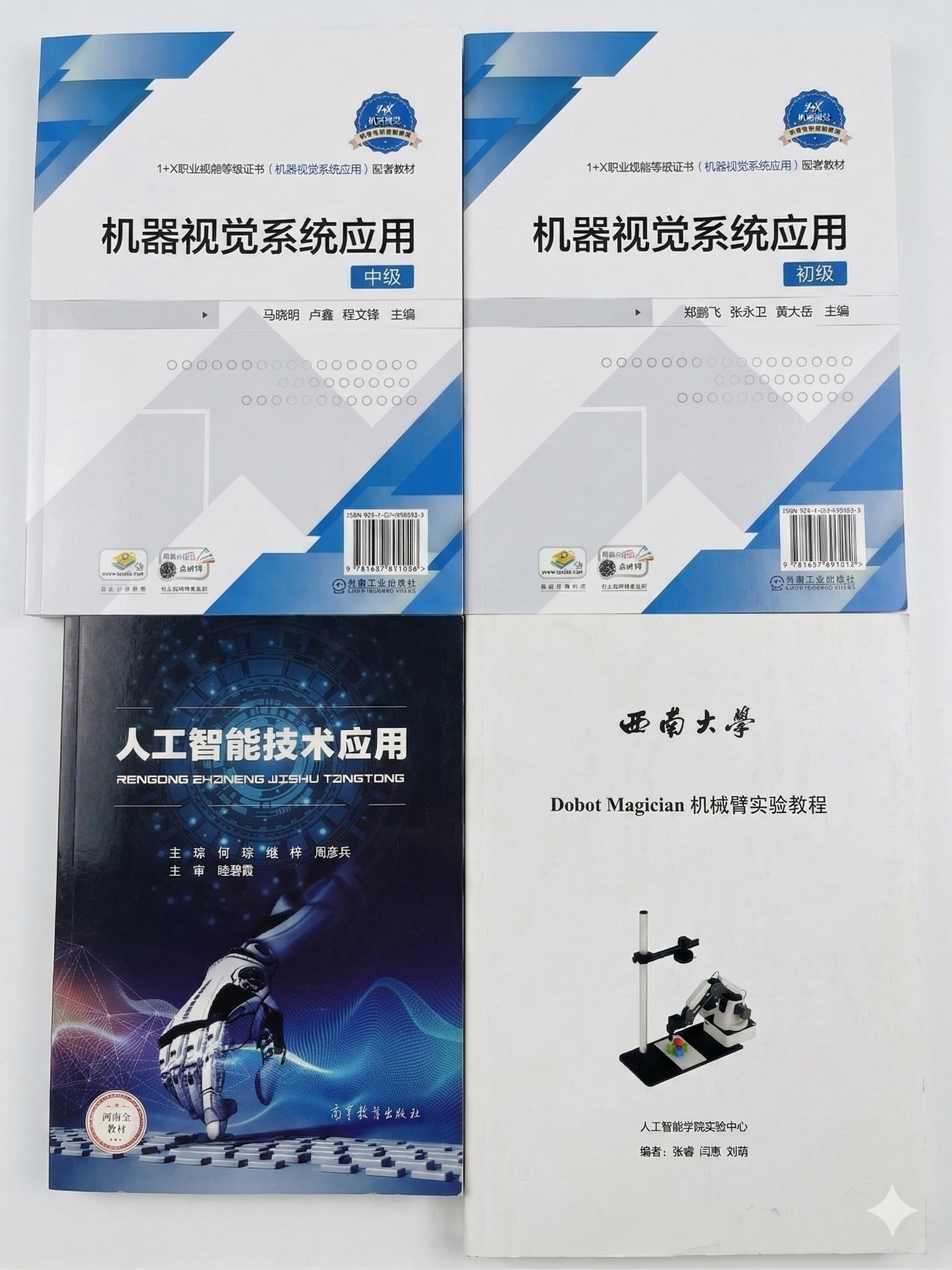
Complete Teaching Resources: Comes with detailed lab manuals, instructional videos, and extended educational materials, making course preparation effortless for educators.
Chia sẻ


Video
Specification parameters
1) Base/Chassis Parameters:
Motor reduction ratio: ≥1:2; Load capacity: ≥12kg; Maximum speed: ≥2.7 m/s; Body weight: ≥6 kg; Dimensions: ≥400mm*500mm; Suspension system: ≥coaxial swing suspension; Off-road wheels: ≥8 inches; Battery capacity: ≥5000mAh; Battery life: ≥6.5 hours (idle) and ≥5.5 hours (3kg load); Motor: DC Brushed Motor; Encoder: AB-phase high-precision encoder; Features: App control supports navigation, map creation, image transmission, obstacle avoidance, and other functions; Support: Supports controllers, with reserved Usart/CAN communication control interfaces and multiple IO interfaces; Operating System: The STM32 board runs on freeRTOS ROS with Ubuntu 18.04 and Melodic
2) Host computer processing unit:
GPU: 384-core NVIDIA Volta ™ GPU with 48 Tensor Cores; CPU: A 6-core NVIDIA Carmel ARM® v8.2 64-bit processor with 6MB L2 and 4MB L3 cache; Visual Accelerator: 7-Channel VLIW Visual Processor; Deep Learning Accelerator: 2 NVDLA Engines; Video memory: 8GB; Video encoding: 2x 4K60|4x 4K30|10x 1080p60|22x 1080p30 (H.265); Video decoding: 2x 8K30|6x 4K60|12x 4K30|22x 1080p60|44x 1080p30 (H.265); Cameras: 2 MIPI CSI-2 D-PHY channels; Connectivity: Gigabit Ethernet, WiFi; Display: HDMI and DP; USB: 4xUSB3.1, USB2.0 Micro-B; I/O: GPIO, I2C, I2S, SPI, UART
3) Lower-level machine processing unit:
CPU: Based on STM32; Core width: ≥32 bits; Maximum clock frequency: ≥72MHz; Communication modes: Supports CAN, I2C, IrDA, LIN, SPI, UART/USART, and USB; Peripheral devices: DMA, motor control PWM, PDR, POR, PVD, PWM, temperature sensor, WDT, crystal oscillator; Input/output count: ≥51; Program memory capacity: ≥256KB; Program memory type: FLASH; RAM capacity: ≥48K; Voltage-Source (Vcc/Vdd): 2 V to 3.6 V; Oscillator type: internal
4) Laser navigation scanning unit:
Range: 0.15-12m; Scan angle: 0-360°; Range resolution: <0.5mm; Angle resolution: ≤1°; Single measurement time: ≤0.5ms; Measurement frequency: ≥4000 Hz; Scan frequency: 1-10 Hz